Dividend Investing for Beginners: How to Build Wealth One Payment at a Time
Sponsored By:

A practical beginner's guide to turning small, consistent investments into an income-producing dividend portfolio.
There are plenty of ways to invest your money, and nearly all of them come with someone promising a faster route to getting rich. Growth stocks, options, cryptocurrency, real estate, private businesses, commodities and an assortment of complicated financial products can make a perfectly intelligent person wonder whether investing requires a degree in astrophysics. Dividend investing for beginners is considerably simpler: you buy shares of businesses, those businesses earn money, and some of that money comes back to you as a dividend. It lacks the thrill of watching a speculative stock double in a week, which is precisely part of its appeal, because dividend investing is built on ownership, patience and compounding rather than prediction.
How Does Dividend Investing Work?
When you buy shares of a dividend-paying company, you become a part owner of that business, and if the company earns a profit and its board approves a dividend, you receive a portion of that profit based on how many shares you own. A company paying a $1 annual dividend would send you $100 a year on 100 shares, and if you reinvest that $100 into additional shares, those new shares begin producing dividends of their own.
Keep doing that for years while adding fresh money from your paycheck and your share count can rise steadily, with each new share adding to the income stream. Eventually the portfolio's income becomes meaningful enough that you stop thinking of dividends as a few dollars appearing in your brokerage account and start seeing them as a genuine path to financial independence.
What Is a Dividend?
A dividend is a cash distribution a company pays to its shareholders out of its profits. Companies can use their earnings in several ways, including reinvesting in the business, paying down debt, making acquisitions, repurchasing shares or returning cash to investors through dividends. Mature, profitable businesses with fairly predictable cash flows are usually best positioned to pay dividends, and while some have paid them for decades, a smaller and more interesting group has raised them consistently for many years.
That history matters because a dividend is only useful if the company can afford to keep paying it. A stock yielding 8% may look far more attractive than one yielding 3%, but if the higher yield comes from a struggling business whose management eventually cuts the payout, the investor who bought it for the yield alone discovers the income was never as secure as it appeared. The beginner's mistake is focusing on the size of the dividend without asking where the money comes from, while the experienced investor starts with the business and works backward to the dividend.
Dividend Yield Explained: Why Yield Is Not the Same as Quality
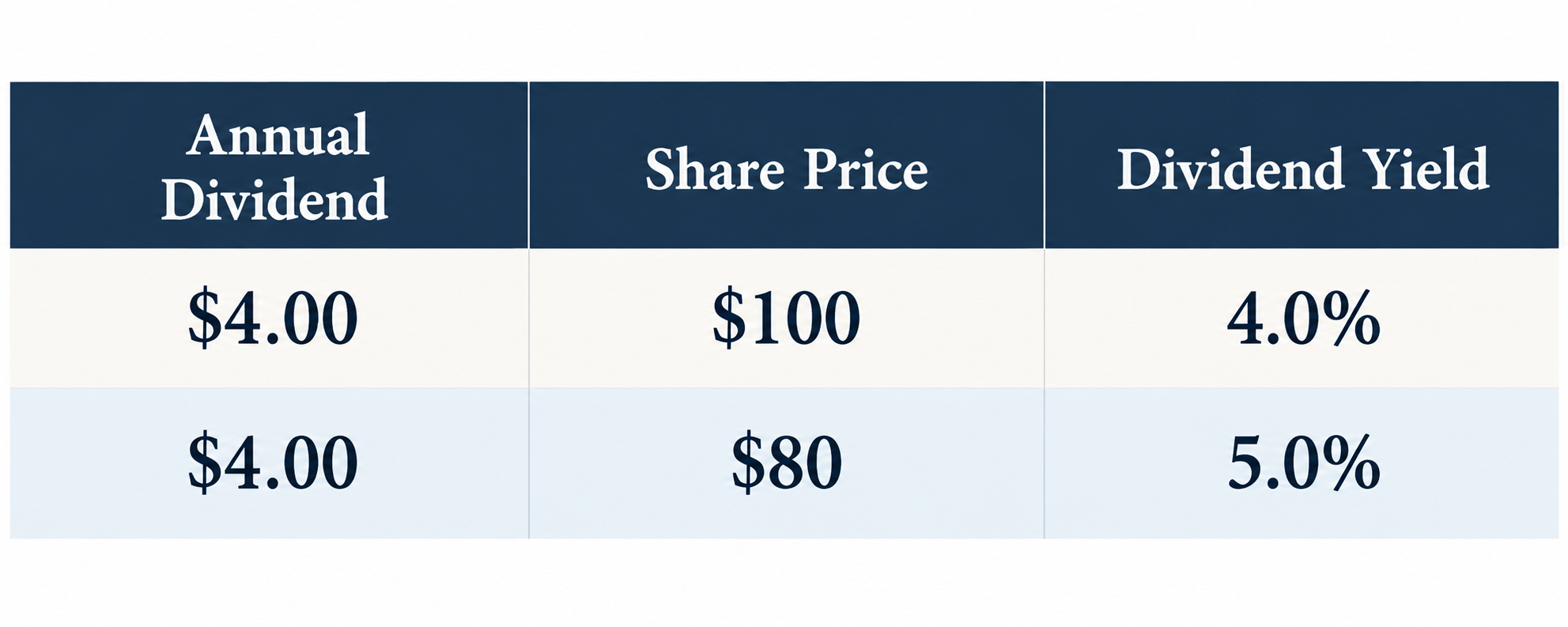
Dividend yield is the annual dividend divided by the stock's current share price, and it is usually the first number beginners encounter. A company paying $4 a year in dividends with a $100 share price yields 4%, but if the stock falls to $80 while the dividend stays the same, the yield jumps to 5%. That higher number does not mean the investment improved, since the share price may have fallen precisely because investors expect earnings to deteriorate in a way that eventually threatens the dividend.
This is why chasing the highest dividend yield is one of the easiest mistakes a new dividend investor can make, and why a sustainable 3% dividend that grows every year can end up far more valuable than an 8% dividend that gets cut. When evaluating any dividend stock, look at earnings, free cash flow, debt, payout ratio, competitive position and the company's history of dividend increases.
You are not buying a percentage; you are buying a business, and the dividend is simply one of the ways that business returns capital to you.
Why Dividend Growth Is the Real Magic
Dividend growth investing is where the strategy becomes genuinely interesting. Suppose you buy shares in a company yielding 3%, an income figure that may not look especially impressive at first. If that company raises its dividend consistently over many years, the income from your original investment can become substantially larger without your buying a single additional share, because the business did the work by increasing what it returns to shareholders.
This is one reason I would rather own a great business with a modest but growing dividend than a mediocre business with a huge yield, since the first has the potential to produce income that grows alongside the underlying company. That growth becomes particularly valuable later in life, when inflation is pushing up the cost of everything from groceries to healthcare to housing, because a dividend that never rises gradually loses purchasing power while one that grows has a fighting chance of keeping up.
There is also something psychologically satisfying about watching your dividend income rise. The market can climb one year and fall sharply the next, but your dividend income offers a different way to measure progress, because even while the share price bounces around you can see that the companies you own keep sending you money. That does not make a falling stock price irrelevant, but it reinforces the long-term ownership mindset that successful dividend investing requires.
How Much Money Do You Need to Start Dividend Investing?
One of the biggest misconceptions about dividend investing is that you need a large sum to get started, when in fact you can begin with whatever amount you are able to invest consistently. Your first dividend might be $3 and the next one $7, followed eventually by $50, then $100, then $500, and while the individual payments matter very little in the beginning, establishing the habit of putting capital to work matters enormously.
The real mistake is waiting for some mythical amount of money before becoming an investor. People tell themselves they will start after the next raise, once the credit card is paid off, when the market dips, when the bonus arrives or when they finally have "enough" saved, and there is always another reason to wait while the years quietly pass. The most valuable ingredient in compounding is not the size of your first investment but the amount of time you give it.
If you can invest $250 a month, start with $250, and if you can manage $500, invest $500. Reaching $1,000 a month eventually gives you a considerably more powerful engine, but the priority is building a system you can maintain through good markets, bad markets, promotions, vacations, recessions and every other distraction life inevitably provides.
Should You Reinvest Your Dividends?
If you are investing for long-term wealth and do not currently need the income, reinvesting your dividends, often automatically through a dividend reinvestment plan (DRIP), can dramatically accelerate the process. Instead of taking each dividend as cash, you use it to buy additional shares, those shares produce additional dividends, and the new dividends buy still more shares in a cycle that keeps repeating.
This is compounding in its simplest form, requiring no complicated algorithm or sophisticated trading strategy, only time and discipline. The frustrating part is that compounding looks unimpressive at first, since a portfolio producing $200 or even $500 in annual dividends hardly feels like a financial revolution, yet eventually the numbers grow large enough that the portfolio's own income contributes a meaningful amount of new capital each year.
Consider what happens when a portfolio produces $10,000 in annual dividends. Reinvesting that money hands your portfolio another $10,000 of capital you did not have to earn through additional work, that capital then has the opportunity to generate more income, and at that point the machine has begun to feed itself.
Dividend Income vs. Total Return: The Goal Is Not Just Income
It is tempting to treat dividend investing purely as an income strategy, but that view misses half the equation, because you are trying to build wealth and income at the same time. A company can pay a dividend while its stock appreciates, so the dividend supplies cash flow while the underlying ownership stake has the potential to grow in value.
That means a dividend investor should care about total return as well as income. A stock yielding 7% that loses 30% of its value because the business is deteriorating is not necessarily a better investment than a stock yielding 3% whose earnings, dividend and share price all grow steadily, since the dividend is one component of your return rather than the entire investment thesis.
This is why the best dividend portfolios usually hold a mix of businesses rather than a pile of the highest-yielding stocks available. Some companies provide higher current income while others deliver faster dividend growth, and some are defensive while others are cyclical, with the objective being a combination that produces income today while preserving the potential for growth tomorrow.
Why Diversification Still Matters for Dividend Investors
Owning dividend stocks does not eliminate the need for diversification, and diversification arguably becomes more important once your portfolio turns into a real source of income, because you do not want a single company's dividend cut to wreck your household budget.
That means thinking about sectors as well as individual companies. Consumer staples, healthcare, financial services, industrials, utilities, energy and real estate all behave differently across the economic cycle, and while you do not need exposure to every sector or dozens of stocks simply to look diversified, you do need to avoid letting one company, one industry or one economic assumption claim an outsized share of your financial future.
Dividend ETFs can play a valuable role here, offering exposure to a broad group of dividend-paying companies without requiring you to research each business individually. For investors who would rather not spend their evenings reading annual reports, that is a perfectly reasonable approach, and there is no extra prize for making investing harder than it needs to be.
What Should Beginners Look for in a Dividend Stock?
No checklist can guarantee a successful investment, but there are several questions every beginner should learn to ask before buying a dividend stock:
Is the company consistently profitable?
Does it reliably generate cash?
Are earnings and free cash flow sufficient to support the dividend?
How much debt does the company carry?
Has the dividend been stable or growing over time?
Does the company have a competitive advantage that protects its business?
Will customers still be buying its products or services five and ten years from now?
Does management take a sensible approach to capital allocation?
The answers will differ from company to company, and that is exactly the point, because you are learning to analyze businesses rather than hunting for a high number beside the word "yield." Procter & Gamble is a different investment from ExxonMobil, Johnson & Johnson is different from Coca-Cola, and a REIT is different again from a technology company, each with its own reasons for owning it, its own risks and its own growth opportunities. Good dividend investing begins the moment you stop treating all dividends as interchangeable.
What Does a Beginner Dividend Portfolio Look Like?
A beginner's dividend portfolio does not need twenty stocks on day one, and trying to build a perfectly diversified portfolio immediately can easily become an excuse for doing nothing at all. Start with a simple structure you understand and expand it as your knowledge grows.
Over time you might own a collection of established dividend growers, a dividend-focused ETF and perhaps a carefully selected group of REITs or other income-producing investments. You may prefer individual companies because you enjoy the research, or funds because you value simplicity, and neither approach is inherently superior so long as the portfolio fits your goals, your risk tolerance and your willingness to do the work required to maintain it.
Your portfolio should also evolve with your circumstances. An investor in their thirties with decades until retirement may emphasize dividend growth and total return, someone approaching retirement may lean toward current income and stability, and someone already living off dividends may prioritize diversification and sustainability above all else, so there is no reason the portfolio you build at 30 should look exactly like the one you need at 60.
How Much Income Can a Dividend Portfolio Produce?
This is where the numbers become interesting. At an average 4% dividend yield, here is roughly what portfolios of different sizes would produce before taxes:
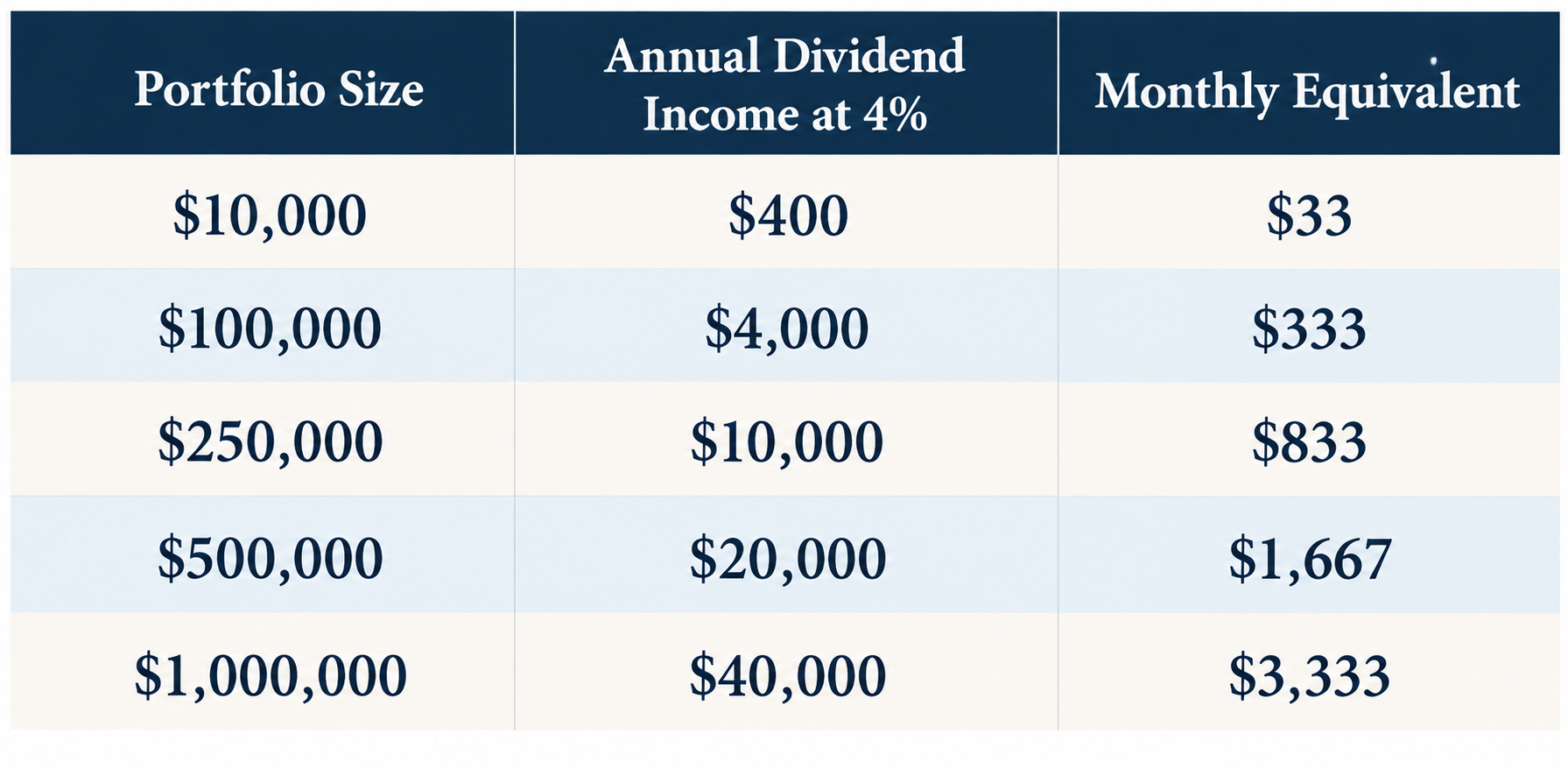
Those figures are not guarantees, and real portfolios never behave with such mathematical tidiness, because yields shift, companies raise or cut dividends, share prices fluctuate and taxes affect what you ultimately keep. The exercise still shows why building capital matters so much: a 4% yield on $10,000 is $400 a year while the same 4% on $1 million is $40,000, and the only thing that changed was the amount of capital.
That is why the Patient Capitalist spends so much time thinking about accumulation, since the dividend matters but the size of the asset generating it ultimately determines how powerful the income stream can become.
Don't Let a Market Decline Scare You Out of a Good Dividend Stock
Every dividend investor eventually lives through a market decline, whether a mild correction or a brutal bear market, and the temptation is always to stare at the shrinking account balance and wonder whether to sell everything until things feel "safe" again. The problem is that the market rarely sends out an announcement telling you when safety has arrived.
A falling share price is not automatically a reason to sell a dividend stock. If the business remains healthy, earnings hold up, cash flow stays strong and management continues to support the dividend, a lower stock price may simply reflect a market that has temporarily cooled on owning the business, which is uncomfortable but not the same thing as permanent impairment.
Sometimes, of course, the business really has changed, and a dividend cut, deteriorating cash flow, excessive debt or a lost competitive advantage can each be a genuine warning. The Patient Capitalist is patient rather than stubborn, and the goal is to hold good businesses for a long time, not to hold bad businesses forever.
Time Is the Dividend Investor's Real Advantage
There is no trick to dividend investing, which is actually the good news. You do not need to predict which stock will double next year, where interest rates will sit in 18 months or how to trade every market cycle; you need to accumulate ownership in productive businesses, reinvest your income when appropriate, add capital consistently and let time do what time does best.
The earlier you begin, the more room compounding has to work. A twenty-year-old investing a modest amount each month holds something an investor starting at fifty cannot buy, namely three additional decades, and while the older investor may have more money to put to work today, the younger one has far more time for dividends to be reinvested, businesses to grow and small contributions to become a meaningful portfolio.
That is why I would not worry much about whether your first investment is perfect. Learn the basics, start investing, keep learning, raise your contributions when you can, reinvest your dividends, review the businesses you own and adjust when the facts change, and then simply keep going.
Frequently Asked Questions About Dividend Investing for Beginners
How do dividends work? When a profitable company's board approves a dividend, shareholders receive a cash payment for each share they own, usually every quarter.
How much money do I need to start dividend investing? You can start with any amount you can invest consistently, since many brokerages allow fractional shares and the habit of investing regularly matters more than the size of your first purchase.
Is a high dividend yield good? Not necessarily, because a high yield is often the result of a falling share price and can signal that the market expects the dividend to be cut.
Should beginners reinvest dividends? If you do not need the income yet, reinvesting dividends through a DRIP buys more shares that produce more dividends, which accelerates compounding.
Are dividend ETFs good for beginners? Dividend ETFs offer broad diversification across many dividend-paying companies without requiring you to research each one, which makes them a sensible option for many new investors.
The Long View
The beauty of dividend investing is that the process is visible: you can watch the income grow, see your share count rise and track your dividends from one quarter to the next, until one day the income your portfolio generates exceeds what you once thought possible. That first $10 dividend will not change your life, and neither will the first $100, but the habit that produces those dividends absolutely can.
Over a long enough period, the objective is an asset that grows steadily more productive. You contribute money, the businesses generate profits and return some of them to you, you reinvest the dividends, your ownership grows, your income grows, and the cycle repeats. There is nothing remotely glamorous about it, which is exactly why I like it.
The financial world is full of people trying to make investing sound complicated, largely because complicated things are easier to sell. Dividend investing strips the idea back to something remarkably simple: own good businesses, collect your share of the profits, reinvest when you can and give the process enough time to matter. You do not have to get rich quickly; you just have to keep getting richer slowly, and that is the dividend investor's lasting advantage.
Views are my own. This article is for educational purposes only and is not investment advice.