The 2026 Christmas Budget: How Much Should You Actually Spend on Your Kids?
Christmas has a funny way of turning perfectly rational adults into competitive shoppers.
Sponsored by:

You start with a simple plan. Maybe you'll keep things reasonable this year. Then your child mentions the one thing they've wanted for six months. Your spouse reminds you about the gifts for nieces and nephews. The school announces a teacher gift. Someone suggests a family gift exchange. Suddenly, the $500 Christmas budget you had in mind has somehow become $1,200.
And that's before you buy the wrapping paper.
The problem isn't that parents want to give their kids a great Christmas. Of course they do. The problem is that holiday spending can become disconnected from the rest of the household budget. A few hundred dollars here, another purchase there, and suddenly January arrives with a credit-card bill that nobody remembers agreeing to.
That's why the most important Christmas shopping decision isn't what to buy.
It's how much you can afford to spend before you start shopping.
So How Much Should You Spend on Christmas?
There isn't one magic number that works for every family.
A household earning $60,000 a year shouldn't necessarily have the same Christmas budget as a household earning $200,000. A family with one child shouldn't necessarily spend the same amount as a family with four. And a family carrying credit-card debt or trying to rebuild an emergency fund has different priorities from a family with substantial savings.
A better approach is to create your Christmas budget based on your own financial situation, rather than what other families appear to be spending.
As a starting point, consider setting aside somewhere between 1% and 2% of your annual take-home pay for total holiday spending, including gifts, decorations, entertaining and other seasonal expenses.
That's a guideline, not a rule.
For a household bringing home $75,000 a year, 1% would be $750 and 2% would be $1,500. A family might decide that $1,000 is the right number. Another might decide that $600 is more appropriate.
The important part is choosing the number before the shopping begins.
Don't Make the Kids' Gifts the Entire Christmas Budget
This is where many families get tripped up.
Parents think about how much they want to spend on their children and forget about everything else that comes with the holidays.
Your Christmas budget may need to cover:
Gifts for your children
Gifts for your spouse or partner
Extended-family gifts
Teacher and caregiver gifts
Stocking stuffers
Holiday meals and entertaining
Decorations
Christmas cards and postage
Wrapping paper and supplies
Holiday travel
Parties and other activities
A $1,000 holiday budget can disappear surprisingly quickly when all of those expenses come out of the same pool of money.
That's why I'd recommend creating two numbers: your total holiday budget and your children's gift budget.
For example, if your family has $1,200 available for Christmas, you might decide that $700 is available for gifts for the kids and $500 covers everything else.
Now you're shopping with a number instead of a feeling.
How Much Should You Spend Per Child?
Again, there's no universal answer.
If you have the financial flexibility, you might spend $300 on each child. If money is tighter, you might spend $100. Neither number is inherently right or wrong.
What matters is that the amount fits your overall financial situation.
One useful approach is to give every child the same planned gift budget, while recognizing that the actual dollar amount of the gifts may vary.
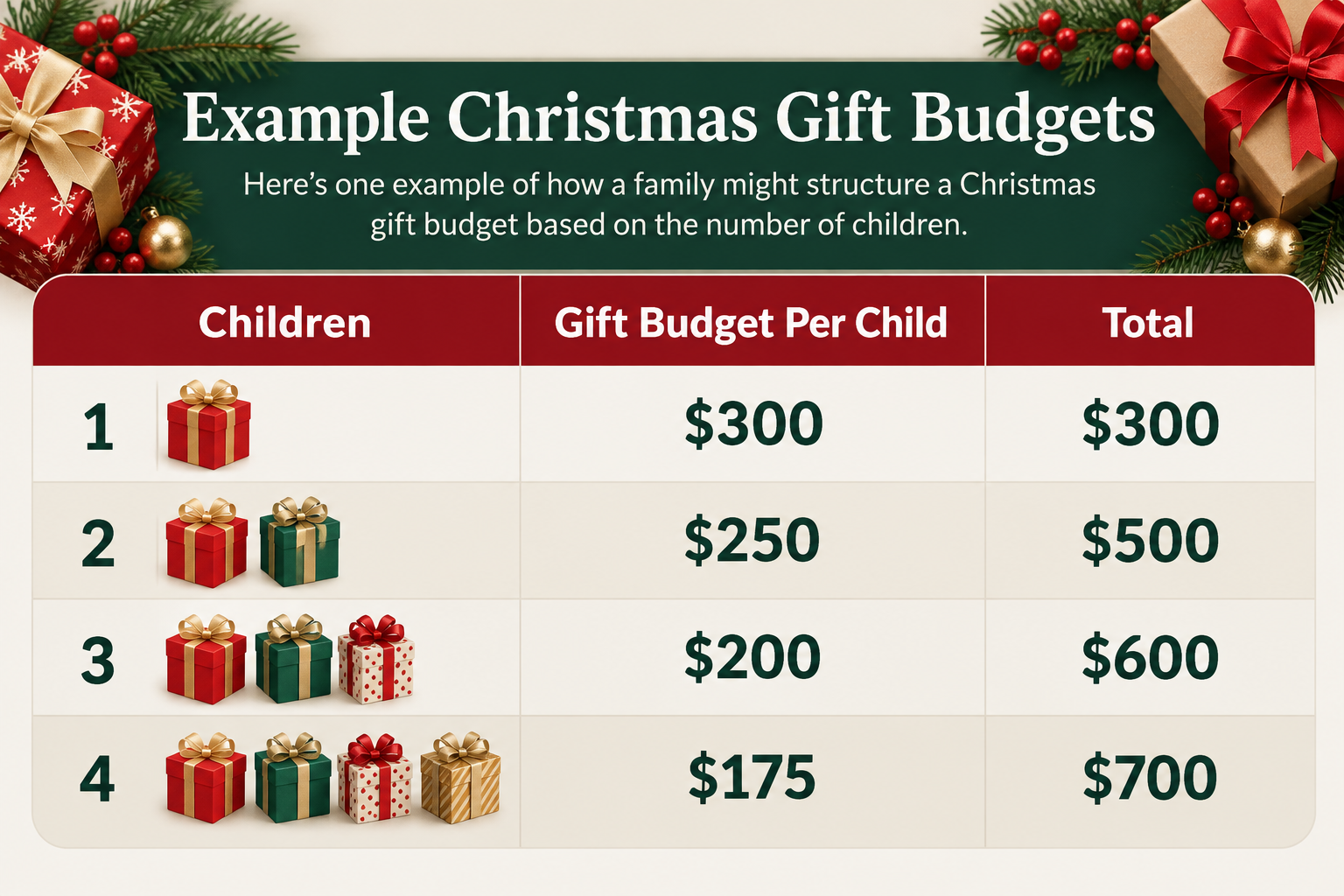
These aren't recommended spending levels. They're simply examples of how a family could structure its budget.
If you have teenagers, you may also find that their gifts cost more than those for younger children. A teenager asking for headphones, athletic equipment or a laptop is playing a completely different financial game than a six-year-old asking for board games and LEGO.
That's another reason equal spending doesn't necessarily mean identical gifts.
Try the "Want, Need, Wear, Read" Approach
One of the easiest ways to prevent gift inflation is to give yourself some boundaries.
A popular framework is:
Something they want.
Something they need.
Something to wear.
Something to read.
You don't have to follow it literally. The point is to establish a framework that prevents Christmas from becoming an unlimited shopping exercise. Many parents feel the number of gifts equals the amount of love they have for their children. That’s silly.
For younger children, this can also make the experience more intentional. Instead of opening a mountain of presents, they get a smaller number of things chosen specifically for them.
And let's be honest: most parents have watched a child spend more time playing with the cardboard box than the $75 toy that came inside it.
Set the Budget Before You Shop
This sounds obvious, but it is one of the most effective strategies.
Decide your total Christmas budget. Then decide how much goes toward each category.
For example:
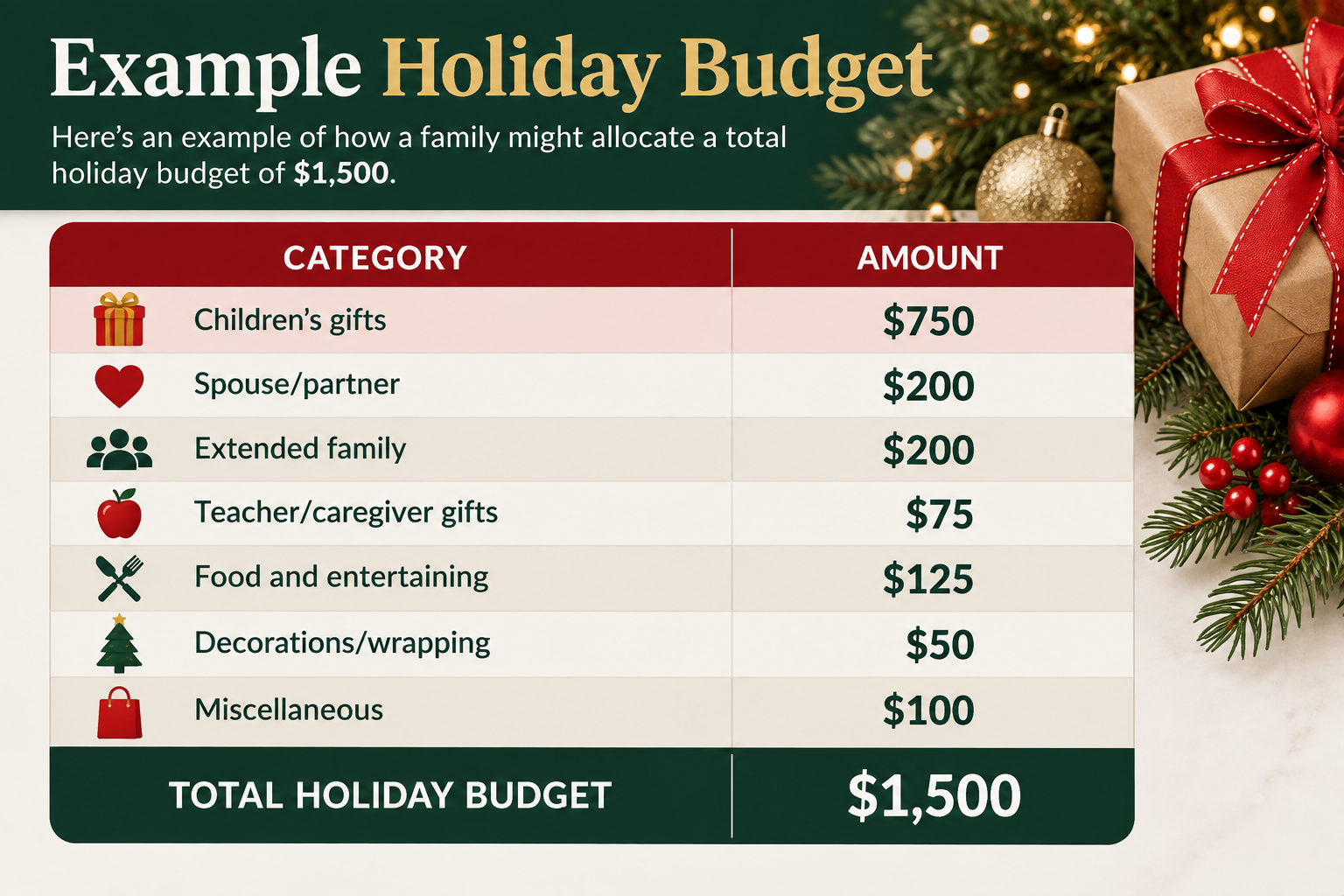
Now you have a spending plan.
Without one, every purchase feels like an individual decision. With one, every purchase has a place.
Don't Let Black Friday Convince You to Spend More
This is particularly important in 2026.
Retailers are expected to offer significant discounts during the holiday season. Adobe expects discounts to reach as high as 30% during Cyber Week, with toys expected to see discounts of up to 29%.
But a discount doesn't automatically save you money.
If you spend $70 on something you didn't plan to buy because it was marked down from $100, you didn't save $30.
You spent $70.
That's an important distinction when you're trying to stay within a Christmas budget.
The best deal is often the item you already planned to purchase that happens to be discounted.
Consider a "Christmas Fund" Instead of a December Panic
If Christmas seems to hit your bank account like a financial truck every December, there's a simple solution: start saving earlier.
Suppose your family wants to spend $1,200 next Christmas.
Instead of finding $1,200 in November and December, save:
$100 per month for 12 months = $1,200.
Or:
$50 per paycheck for 24 paychecks = $1,200.
The math isn't complicated. The advantage is psychological. You're turning a large, painful expense into a series of small, predictable contributions.
And once the money is sitting in a separate holiday savings account, you don't have to wonder whether you can afford that next gift.

What If You Can't Afford Your Normal Christmas Budget?
This is where parents need to give themselves permission to change the plan.
If your household finances are tighter this year, spending the same amount you spent last year simply because you don't want your kids to notice isn't necessarily a good financial decision.
Kids don't need parents to go into debt to create a memorable Christmas.
You can reduce the number of gifts. Set spending limits with relatives. Shop secondhand. Buy fewer but more meaningful items. Make some gifts. Start family traditions that don't revolve around spending money.
And if you're buying for a large extended family, consider suggesting a gift exchange rather than everyone buying something for everyone else.
That isn't being cheap.
It's establishing a budget.
Be Careful With Buy Now, Pay Later
Holiday shoppers are increasingly using installment-payment options, and Adobe expects more than $21 billion in online holiday purchases to involve Buy Now, Pay Later in 2026, up 6.6% from the prior year.
The problem is that splitting a purchase into four payments can make a $200 purchase feel like a $50 decision.
It isn't.
It's still a $200 purchase.
If you're using BNPL because it genuinely helps manage cash flow and you already have the money budgeted for the purchase, that's one situation. If you're using it because you can't otherwise afford the Christmas gifts you're buying, that's a warning sign.
Don't let January inherit December's spending decisions.
The KMONEY Christmas Budget Test
Before buying something, ask yourself three questions:
Was it in my budget?
Would I still buy it if it weren't on sale?
Will I be happy I bought it when the credit-card bill arrives in January?
If the answer to all three is yes, you're probably making a deliberate purchase.
If the answer is no to two or three of them, put the phone down and walk away.
Your kids will survive.
A Christmas Budget Should Make the Holiday Better, Not Worse
The goal of a Christmas budget isn't to make the holiday less fun.
It's to make sure the fun doesn't come with three months of financial regret.
Kids don't experience Christmas as a spreadsheet. They remember traditions, experiences, excitement, family, food, movies, games and the feeling that something special is happening.
That doesn't mean gifts don't matter. They do. But there's a big difference between giving your children a wonderful Christmas and trying to manufacture a perfect Christmas through spending.
The best Christmas budget is the one that lets you enjoy December and still like your bank account in January.
So before you start filling your online shopping cart this year, decide what Christmas can realistically cost your family.
Then stick to it.
That's the real Christmas deal.
KMONEY Holiday Budget Calculator
Want to know what your family can realistically spend?
Start with your annual take-home household income, decide what percentage you're comfortable allocating to the holidays, and then divide that amount across gifts, food, travel and other seasonal expenses.
For example:
$75,000 take-home income × 1.5% = $1,125 total holiday budget
From there, you can decide how much goes toward your children, spouse, extended family and everything else.
We'll be adding more KMONEY tools to help families make these decisions with actual numbers instead of guesswork.
Good luck!
This article is for general informational purposes and isn't individualized financial advice. Your appropriate holiday budget depends on your income, expenses, savings, debt and other financial circumstances.