

What Your 18-Year-Old Should Know About Money Before Leaving Home


A parent-friendly financial checklist covering checking accounts, credit cards, credit scores, taxes, budgeting, investing and debt.
Here's a fun fact that should terrify every parent: the day your kid turns 18, credit card companies, car dealers, and "buy now, pay later" apps will treat them like a fully grown adult.
Meanwhile, most schools still don't teach them how any of it works. This is a crime.
So, the job falls to us. And honestly, it should. We spend 18 years teaching our kids to look both ways before crossing the street, wear a seatbelt, and not eat the thing they found under the couch. But a lot of kids leave home without ever learning how interest works, what a credit score is, or why their first paycheck is so much smaller than they expected.
The money mistakes kids make at 18 to 22 can follow them for a decade. The good habits they build in those same years can set them up for life.
This post is your checklist. It covers the seven money skills I think every kid should have before they leave home, whether they're heading to college, the military, a trade, or their first full-time job.
KMONEY tip: Don't wait until the night before move-in to cover all of this. Start around 15 or 16 and work through one topic at a time. Money conversations stick better as a series of small talks than one giant lecture. (Ask me how I know.)
1. Checking and Savings Accounts: The Foundation
Before your kid can manage money, they need somewhere to put it. This sounds basic, but plenty of 18-year-olds have never logged into a bank app, set up direct deposit, or seen a bank fee.
What they should know:
Checking vs. savings. Checking is for spending money. Savings is for money you're not spending. Mixing the two is how "emergency funds" turn into pizza funds.
How overdrafts work. If you spend more than you have, many banks will let the charge go through and then hit you with a fee. One $4 coffee can cost $39 if the timing's wrong. Show them how to turn off overdraft coverage or link a backup account.
How to read a statement. Have them go through a month of transactions and identify every charge. (Bonus: this is great subscription-trap training.)
Direct deposit. Their first employer will ask for account and routing numbers. They should know where to find them.
Payment app safety. Venmo, Zelle, and Cash App payments are basically cash. Send money to the wrong person or a scammer, and it's usually gone for good.
The KMONEY move: Open a student checking account with your teen before they leave, ideally at a bank with no monthly fees and a good app. Turn on low-balance and large-purchase alerts together. Then let them manage it themselves while they're still under your roof, when mistakes are cheaper and you're around to help.
Also set up a separate high-yield savings account for their emergency fund. Even $500 to $1,000 set aside is the difference between a flat tire being an inconvenience and a flat tire being a credit card balance.
2. Budgeting: Where the Money Actually Goes
Most teenagers have never budgeted, because until now you've been the budget.
What they should know:
Income minus spending equals the whole game. If more goes out than comes in, it doesn't matter how much they earn.
A simple framework. The 50/30/20 rule is a great starting point: roughly 50% for needs (rent, food, transportation), 30% for wants (fun), and 20% for savings and debt payments.
Irregular expenses exist. Textbooks, car registration, holiday travel, and birthday gifts don't happen every month, but they happen every year. Plan for them.
Small purchases add up. A $7 daily coffee-and-snack habit is about $2,500 a year. Wha-wha-what?!?!?
The KMONEY move: Have your teen build a real budget for their first semester or first apartment. Research actual costs together: rent, groceries, phone, gas, insurance, subscriptions. The number is always higher than they expect, and that "whoa" moment is exactly the point.
3. Credit Scores: Their Financial Report Card
A credit score is a three-digit number that tells lenders how likely you are to pay them back. It affects whether your kid can rent an apartment, how much they'll pay for a car loan, and even whether some employers or insurers look at them favorably.
What they should know:
The most widely used score, FICO, is based on five things:
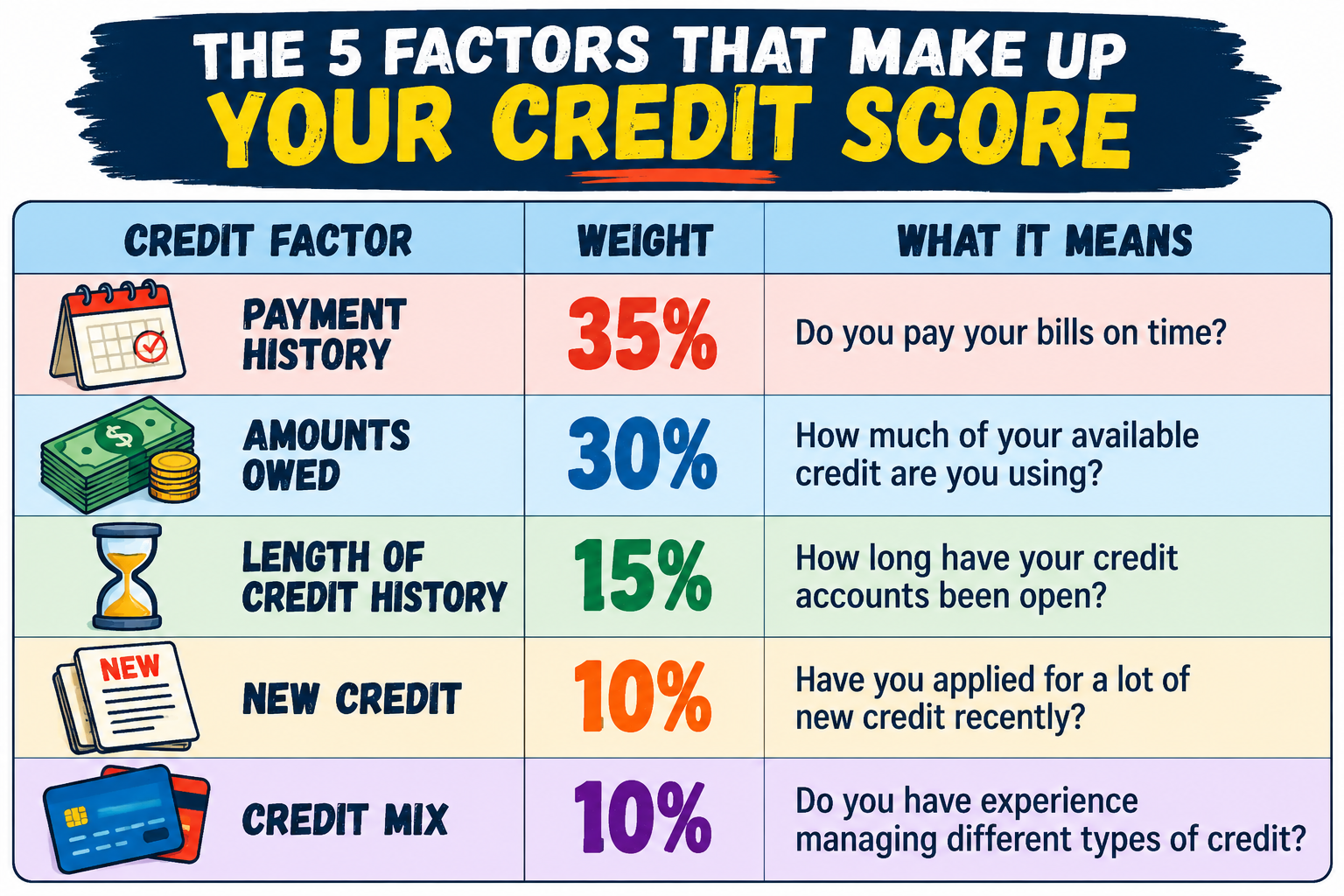
One important note: These percentages are commonly associated with the FICO Score, but FICO says the exact importance of each factor can vary depending on the individual’s credit profile.
The takeaway for your kid: pay on time, every time, and don't max out your cards. That covers about two-thirds of the score right there.
Check it for free. They can get their credit reports free at AnnualCreditReport.com, and many banks and card apps show their score for free.
Late payments hurt for years. A payment 30+ days late can stay on a credit report for seven years.
Time is an asset. The earlier they start building credit responsibly, the better their score will be when they need it most, like for their first apartment or car.
The KMONEY move: Consider adding your teen as an authorized user on one of your credit cards with a long history and low balance. They can benefit from your good payment history, often without you even giving them the physical card. Just be sure your own habits are solid first, because your late payments could hurt them too.
4. Credit Cards: A Tool, Not Free Money
Credit cards aren't evil. Used right, they build credit, offer fraud protection, and can even earn rewards. Used wrong, they're one of the fastest ways for a young adult to dig a hole.
What they should know:
How interest actually works. Here's the example I'd show every teenager:
Say your kid puts $1,000 on a card with a 22% interest rate.
If they pay $30 a month, it takes over 4 years to pay off and costs about $1,560 total.
If they pay $100 a month, it's gone in about a year, for about $1,115 total.
If they pay it in full when the bill arrives, it costs exactly $1,000. No interest.
Same purchase. Wildly different cost.
The minimum payment is a trap. It's designed to keep you in debt as long as possible.
Keep utilization low. Try to use less than 30% of the credit limit, and ideally under 10%. A $500 limit means keeping the balance under $150.
The golden rule: Only charge what you already have the cash to pay for. If they couldn't buy it with their debit card, they can't afford it on the credit card.
A quick note on the law: under federal rules, applicants under 21 generally need to show independent income or have a cosigner to get their own credit card. That's why the authorized-user route above is so popular.
The KMONEY move: Once your kid is ready for their own card, start with a no-annual-fee student or starter card with a low limit. Put one small recurring bill on it (like their phone or a streaming service) and set up autopay for the full statement balance. That builds credit on autopilot with almost zero risk.
5. Taxes: Why Their Paycheck Shrank
Nothing humbles a teenager faster than their first paycheck. "I worked 20 hours at $15 an hour. Where's my $300?"
What they should know:
Gross vs. net pay. Gross is what you earn. Net is what actually lands in your account after taxes and deductions.
What's being taken out. Federal income tax, state and local income tax (depending on where they live), and 7.65% for Social Security and Medicare (also called FICA).
The W-4. This is the form they'll fill out for every new job. It tells the employer how much tax to withhold. They should understand it, not just sign it.
Filing a tax return. Even if they don't earn much, filing can get them a refund of taxes that were withheld. There are free filing options available.
Dependent status matters. If you're still claiming them as a dependent (which is common for full-time students), they need to check that box when they file. Coordinate this so you don't both claim it.
Side gig income is different. DoorDash, freelance work, and reselling usually don't withhold taxes. A good rule of thumb is to set aside 25% to 30% of that income for taxes so April doesn't come with a surprise bill.
The KMONEY move: Sit down with your teen and file their first tax return together, even if it's tiny. Walk through the W-2 line by line. Thirty minutes at the kitchen table can save them years of confusion and a lot of fear of the IRS.
6. Investing: Time Is Their Superpower
Here's the thing your 18-year-old has that you and I will never have again: time.
What they should know:
Compound growth is the real magic. Money you invest earns returns, then those returns earn returns.
Starting early crushes starting big. $100 a month invested from age 18 to 65 at a 7% average return could grow to about $439,000. Wait until 28 to start the same $100 a month, and it's about $210,000. Ten years of waiting costs them more than half. (Returns are hypothetical and not guaranteed, but the principle is rock solid.)
The Roth IRA is their best friend. If they have earned income, they can contribute to a Roth IRA. The money grows tax-free, and they'll pay no tax on qualified withdrawals in retirement. For young, low-income earners, it's about as good as it gets.
Always take the free money. If their first employer offers a 401(k) match, they should contribute at least enough to get the full match. Skipping it is turning down part of their paycheck.
Keep it simple. They don't need to pick stocks. A low-cost, broad index fund or target-date fund is a great place for a beginner to start.
Ignore the hype. If someone on TikTok or at a party promises guaranteed fast returns, it's either a gamble or a scam. Real investing is boring. That's a feature.
The KMONEY move: If your teen has a summer or part-time job, open a custodial Roth IRA and offer to "match" some or all of what they contribute (up to what they earned). It's the best 401(k) match they'll ever get, and it teaches them to invest with real skin in the game.
7. Debt: Know Before You Owe
Not all debt is created equal, and your kid should know the difference before they sign anything.
What they should know:
Productive vs. destructive debt. A reasonable student loan for a degree with good earning potential, or a mortgage on a home, can be productive. Credit card debt for a spring break trip is destructive.
Student loans are real money. Your kid should know exactly how much they're borrowing, the interest rate, and roughly what the monthly payment will be after graduation. Federal loans generally come with more protections and repayment options than private loans. The repayment rules also just changed for new loans, which is another reason to read the fine print.
A good rule of thumb: Try to keep total student loan debt below what they expect to earn in their first year out of school.
Car loans can sneak up on them. A shiny car with a six- or seven-year loan can eat a first paycheck alive. Reliable and used beats new and financed.
"Buy now, pay later" is still debt. Splitting a $200 purchase into four payments feels painless, but stacking several of these at once is how young adults lose track of what they owe.
Never cosign casually. If a friend or roommate asks your kid to cosign a loan or lease, the answer should almost always be no. Cosigning means you're fully on the hook.
The KMONEY move: Before your kid signs any loan, have them calculate the total cost, not just the monthly payment. Dealers and lenders love to talk monthly payments because it hides the real number.
Bonus: Protecting Themselves
A few more things that don't fit neatly into a category but absolutely belong on the list:
Scams target young adults. Fake job offers, "you won a prize" texts, crypto schemes, and fake landlords asking for deposits by Zelle. The rule: if it's urgent and wants money or personal info, it's probably a scam.
Freeze their credit if they aren't using it. A credit freeze is free and prevents anyone from opening new accounts in their name.
Guard their Social Security number. They should know where their card is and rarely, if ever, carry it.
Insurance basics. Renters insurance is usually cheap and covers their stuff. They should also know that they can typically stay on your health insurance until 26 and carry a copy of their insurance card.
Key documents. Make sure they have (or know where to find) their birth certificate, Social Security card, passport, and insurance info.

The Printable Checklist
Print this out, stick it on the fridge, and check items off together over the next year or two:
🏦 Banking
Has their own checking account and knows how to use the app
Has a savings account with a starter emergency fund
Understands overdraft fees (and has overdraft coverage turned off)
Knows their account and routing numbers for direct deposit
Understands payment app risks (Venmo, Zelle, Cash App)
📊 Budgeting
Has built a real monthly budget
Knows the 50/30/20 rule
Plans for irregular expenses
📈 Credit
Understands what makes up a credit score
Knows how to check their credit report for free
Is building credit (authorized user or starter card)
Pays credit cards in full every month
Understands how interest and minimum payments work
🧾 Taxes
Understands gross vs. net pay
Knows how to fill out a W-4
Has filed (or helped file) a tax return
Knows to set aside money for side gig taxes
💰 Investing
Understands compound growth
Knows what a Roth IRA and 401(k) match are
Has started investing, even a small amount
⚠️ Debt
Knows the difference between productive and destructive debt
Understands the full cost of their student loans
Knows to calculate total cost, not just the monthly payment
Understands the risks of cosigning and "buy now, pay later"
🔒 Protection
Can recognize common scams
Knows about credit freezes
Has copies of key documents and insurance info
Final Thoughts
You don't have to be a financial expert to teach your kids about money. You just have to be willing to have the conversations, share your own mistakes (we've all got a few), and let them practice while the stakes are still low.
The greatest inheritance you can give your kids isn't money. It's knowledge. A kid who leaves home knowing how to budget, build credit, avoid bad debt, and invest early has a head start most adults never get.
And if they still call home asking for money? Well... some things never change.
Want more money tips for every stage of parenthood, from diapers to dorm rooms? Join thousands of fellow parents who get my free newsletter every Wednesday. Subscribe here.
Disclaimer: All of the information found on this site is for educational purposes only, and should not be considered financial, tax, or legal advice. Consult a financial professional before making any major financial decisions.
Have you thought about starting your own blog or newsletter? Well, you should. Sign up with Beehiiv and use promo code KMONEY and get 20% off your first 3-months + 14-day Free Trial.